
You don’t need flashcards, a therapy room or a cart full of special toys. The best speech practice for a toddler happens at the kitchen table, in the bathtub and on the living room floor.
When parents ask me for speech therapy activities for toddlers at home, they’re often bracing for homework: drills, worksheets, a timer. What I give them instead is a handful of small changes to things they already do every day. In my experience, those small changes, repeated many times a day, do more for a toddler’s words than a single long “practice session” ever will.
That isn’t just my opinion. Research on parent-led language support has found that toddlers make real gains when parents learn a few simple strategies and use them during everyday routines (Roberts & Kaiser, 2011). Here are the ten activities I recommend most, plus the three habits that make every one of them work.
Key takeaways
- Short moments, many times a day, beat one long practice session.
- Get face to face, wait longer than feels natural, and add just one word to what your child says.
- Meals, bath time, getting dressed, books and songs are all built-in practice time.
- Never pressure a child to “say it.” Make talking the easiest way to get something they want.
- If your 2-year-old isn’t combining two words or you’re worried, talk to your pediatrician and ask about an evaluation. You don’t have to wait.
3 habits that make every activity work
Before the activities, learn these three habits. They’re the same tools I use in therapy, and they turn ordinary moments into speech practice.
1. Get face to face
Get down to your child’s eye level, on the floor, across the high chair tray or kneeling by the tub. When your toddler can see your mouth and your face, they can watch how words are made and they’re more likely to try copying you.
2. Wait (longer than feels comfortable)
Most of us jump in too fast. After you offer a choice or pause a game, look at your child expectantly and silently count to five. That quiet space is an invitation. Many toddlers will fill it with a sound, a sign or a word if we give them time.
3. Add one word
Whatever your child says, say it back with one more word. If they say “ball,” you say “big ball” or “roll ball.” If they say “car go,” you say “car go fast.” This is called expansion, and it shows your child the next step without correcting them.
A note from clinical practice
The parents whose children make the fastest progress in my practice are rarely the ones doing the most “drills.” They’re the ones who learned to stop, wait and add one word, and then did it at breakfast, at bath time and in the car. Consistency matters far more than the activity itself.
10 everyday speech activities for toddlers
1. Snack time choices
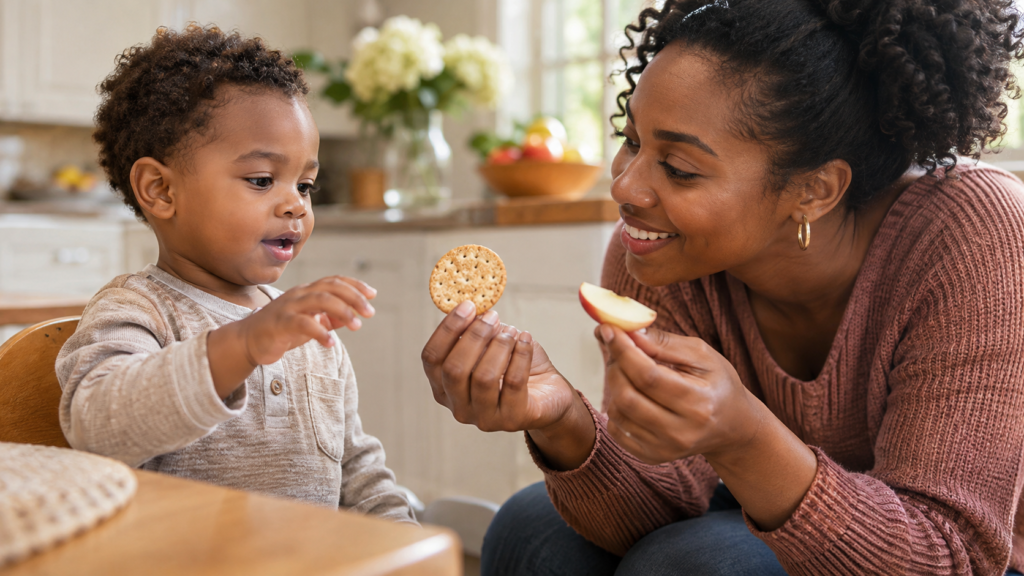
Hold up two snacks, one in each hand, and ask, “Crackers or apple?” Hold them near your face so your child looks toward your mouth. Then wait. If your child points or reaches, model the word (“Apple!”) and hand it over. Accept any attempt, even “ah” for apple. The goal is to show that words get results.
Words to model: more, all done, open, eat, drink, the names of favorite foods.
2. “Ready, set… go!” games
Roll a ball, push a car down a ramp or lift your child for a swing. Say “Ready, set…” and then pause before “go.” After a few rounds, most toddlers start to fill in the word, or at least a sound, because they want the fun to continue.
Words to model: go, stop, again, up, down, wheee.
3. Bubbles

Bubbles are a speech therapist’s favorite tool for a reason: toddlers love them and they can’t blow them alone. Blow a few, then put the lid back on and wait. Your child may hand you the bottle, sign “more” or try a word. Pop bubbles together and say “pop!” every time.
Words to model: bubbles, more, pop, blow, up, big, all gone.
4. Bath time talk
Narrate what your child is doing using short, simple phrases: “Splash! Wash feet. Wash tummy. Water is warm.” This is called parallel talk. You’re putting words to your child’s actions as they happen, which is exactly when those words are easiest to learn. Cups for pouring and a few floating toys give you plenty to talk about.
Words to model: splash, wash, pour, wet, in, out, body parts.
5. Getting dressed
Dressing is a daily vocabulary lesson. Name each item and body part as you go: “Shirt on. Arms in. Where are your feet? Socks on feet!” Let your child choose between two shirts or two pairs of socks and wait for a response. Pointing to body parts is also a milestone the CDC looks for around age two.
Words to model: on, off, shoes, socks, hat, head, feet, hands.
6. Book sharing (not book reading)
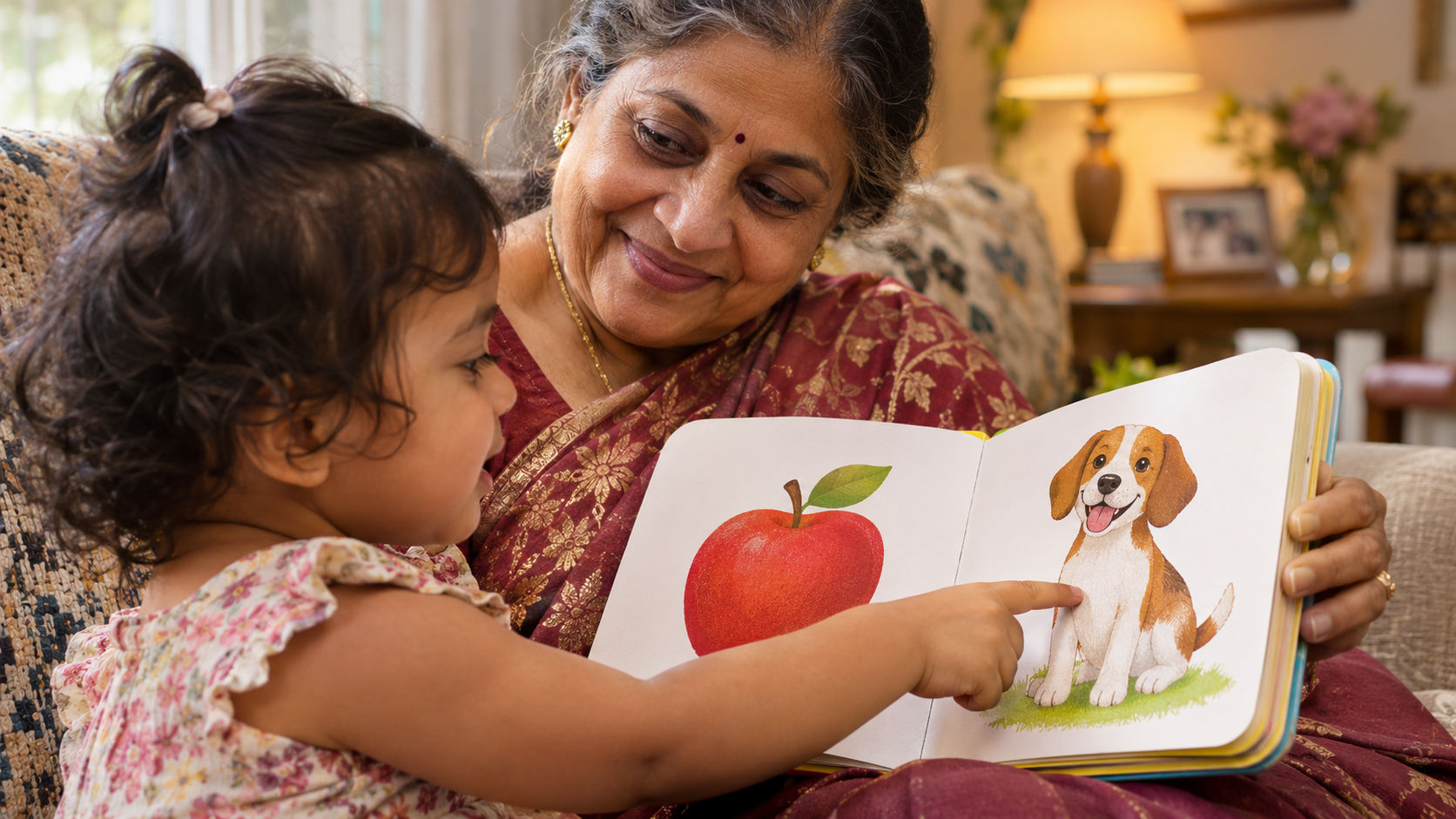
With toddlers, you don’t have to read every word on the page. Point to pictures, name them and leave pauses: “Look, a dog! The dog says…” Then wait. Board books with simple pictures and repeated lines work best. Avoid turning it into a quiz (“What’s this? What’s this?”). Comment more than you question.
Words to model: animal names and sounds, look, uh-oh, big, little, the names of characters.
7. Songs with a missing word
Sing familiar songs like “Twinkle, Twinkle, Little Star” or “Wheels on the Bus,” then stop just before a predictable word: “Twinkle, twinkle, little…” Pause and look at your child. Songs carry words on rhythm and repetition, so the missing word is easy to predict, and many toddlers try their first fill-in words this way. You can read more about music and early speech.
Words to model: the last word of each line, plus actions like clap, round and round, swish.
8. “Oops, I need help” moments
Create small, friendly problems your child needs you to solve. Put a favorite toy in a clear container they can’t open. Give them a bowl but no spoon. Hand them one shoe. These moments give your child a reason to communicate. When they bring the container to you, model the word: “Open! You want open.” Keep it playful, never frustrating.
Words to model: help, open, uh-oh, spoon, where, my turn.
9. Car rides and grocery trips
Errands are full of things to name. In the car, point out what you see: “Bus! Big bus. Red light, stop.” At the store, let your child hold an item and name it as it goes in the cart: “Bananas in.” You don’t need a conversation. Short labels and a little enthusiasm are enough.
Words to model: car, truck, bus, stop, go, in, food names.
10. Pretend play
Feed a stuffed animal, put a doll to bed or cook in a toy kitchen. Pretend play is where toddlers begin putting two words together: “baby eat,” “night night bear.” Follow your child’s lead, copy what they do with the toys and add one word to what they say. Simple toys you already own work well. Here’s my list of toys that help speech and language.
Words to model: eat, sleep, hot, yummy, night night, hug, wash.
A note from clinical practice
If your child isn’t saying many words yet, simple signs like “more,” “help” and “all done” are a great bridge. Signing does not stop a child from talking. In my experience, it lowers frustration and often speeds up spoken words. Learn more about using sign and gesture with late talkers.
The 10 activities at a glance
| Activity | When | Main skill | Try saying |
|---|---|---|---|
| Snack time choices | Meals and snacks | Requesting | “Crackers or apple?” |
| “Ready, set… go!” | Playtime | Filling in a word | “Ready, set…” |
| Bubbles | Playtime | Asking for more | “More bubbles?” |
| Bath time talk | Bath | Action words | “Splash! Wash feet.” |
| Getting dressed | Mornings | Body parts and clothing | “Socks on feet!” |
| Book sharing | Bedtime, quiet time | Naming and pointing | “The dog says…” |
| Songs with a missing word | Anytime | Filling in a word | “Twinkle, twinkle, little…” |
| “Oops, I need help” | Playtime, meals | Asking for help | “You want open?” |
| Car rides and errands | Out and about | Labeling | “Big bus!” |
| Pretend play | Playtime | Two-word phrases | “Baby eat. Baby eat cracker.” |
What to skip
- Don’t demand words. “Say ‘cup.’ Say it. Say ‘cup'” usually leads to a shutdown. Model the word, wait, and give the cup either way.
- Don’t quiz. A string of “What’s this?” questions feels like a test. Try to make more comments than questions.
- Turn off background TV. A TV playing in the background cuts down on the back-and-forth talk toddlers learn from. Save screens for a set time, and watch together when you can.
- Don’t correct pronunciation. If your child says “nana” for banana, just say “Yes, banana!” back. They’ll hear the full word without feeling wrong.
Most of all, keep it fun. A toddler who is enjoying themselves will try new words. A toddler who feels pushed will go quiet. I wrote more about this in why speech therapy should be fun.
When home practice isn’t enough
These activities help every toddler, but they’re not a substitute for an evaluation when something is off. By age two, the CDC expects most children to (CDC milestones):
- Say at least two words together, like “more milk”
- Point to things in a book when you ask, like “Where is the bear?”
- Point to at least two body parts when asked
- Use more gestures than waving and pointing, like blowing a kiss or nodding yes
If your child isn’t doing one or more of these, has lost words or skills they used to have, or you just have a nagging feeling, talk to your pediatrician and ask about a speech and language evaluation. Don’t wait to see if they grow out of it. If your child is under three, you can also contact your state’s Early Intervention program directly; evaluations are often free.
Not sure whether your child is a late talker or has a speech delay? Start with late talker vs speech delay or when should a child start talking.
Trust your instincts
You know your child better than anyone. Starting therapy early never hurts, and the activities in this article will keep helping alongside it. Many of the families I work with use these exact routines between sessions.
Frequently asked questions
How much time should I spend on speech practice at home each day?
Think in moments, not minutes. A few minutes during snack time, bath time, dressing and a book adds up to a lot of practice. Short and frequent works better for toddlers than one long session they’ll lose interest in.
Can I do speech therapy at home without a speech therapist?
You can do a lot to support your child’s language at home, and these activities are a great start. But home practice isn’t the same as therapy. A speech-language pathologist can find out why your child isn’t talking yet and build a plan for them. If you’re worried, get an evaluation and use these activities alongside it.
Do speech apps or videos help toddlers talk?
Toddlers learn to talk through back-and-forth interaction with people. A screen can’t wait for your child, respond to their attempts or add one word to what they said. If you use an app or video, watch together and talk about it. Real interaction should be the main event.
Should I use sign language with my toddler?
Yes, simple signs like “more,” “help” and “all done” can reduce frustration and support spoken words. Always say the word out loud as you sign it.
Do I need to buy special toys for speech practice?
No. Bubbles, a ball, a few board books, a toy car and a stuffed animal cover almost everything in this article. The toy matters less than how you play with it: face to face, with pauses and simple words.
What if my toddler won’t copy me?
That’s common. Keep modeling without pressure, and celebrate any attempt: a sound, a sign, a look or a gesture all count as communication. If weeks go by with little change, or your child seems frustrated, it’s a good time to talk to your pediatrician about an evaluation.