
When Should a Child Start Talking? Real Milestones Explained
- Most children say their first real words around 12 months, but the range of normal is wide
- Communication begins long before words — babbling, pointing, and gestures all matter
- What counts as a word is broader than most parents realize
- Certain signs at any age are worth discussing with a professional sooner rather than later
- What age should a child start talking?
- Before talking comes communication
- What counts as a first word?
- Speech and language milestones by age
- When should parents worry about late talking?
- Why some children talk later than others
- What parents can do to encourage talking
- When to seek a speech evaluation & FAQ
What Age Should a Child Start Talking?
Most children say their first real words around 12 months of age, though some start a little earlier and others a little later. Words like mama, dada, ball, bye-bye, or up often appear first — and they do not need to be pronounced perfectly to count.
By 18 months, many toddlers have a small but growing set of spoken words. By age 2, most are beginning to combine words into short phrases like “more milk” or “mommy go.” That said, speech development is not only about talking. It also includes understanding language, using gestures, making eye contact, taking turns, and trying to communicate in many ways.
Here is a quick reference for when key milestones typically appear:
| Age | Typical milestone | Approximate word count |
|---|---|---|
| 4–6 months | Babbling begins | No words yet |
| 9–12 months | Gestures, imitating sounds, first words emerging | 0–3 words |
| 12–18 months | First words appear, vocabulary slowly growing | 1–20 words |
| 18–24 months | Vocabulary expands, two-word phrases begin | 20–50+ words |
| 2–3 years | Short sentences, rapid vocabulary growth | 200–1,000+ words |
These ranges are guides, not rules. A child who is slightly outside a range but showing steady progress across all areas of communication is usually doing well. What matters most is the full picture — not any single number.
Before Talking Comes Communication
A child does not go from silence to words overnight. Speech grows out of earlier communication skills that begin in the first weeks of life. Many parents focus on words, but I always tell families: watch for communication first. A child who is not yet talking but is pointing, responding, imitating, and understanding language is showing very encouraging signs.
Here are the building blocks that come before words — and that support language development all the way through:
To understand how these early skills fit into the broader picture of child development, see our full guide to child development milestones from birth through age five.
What Counts as a First Word?
Parents often wonder whether a sound their child makes really counts as a word. The answer is broader than most people expect. A true first word does not need to sound like the adult version — it only needs to be used consistently and with clear meaning.
What matters is not pronunciation. What matters is intention. If a child uses the same sound in the same situation repeatedly and clearly means something by it, that is a real word.
Each of these counts as a word if used consistently and with meaning:
This matters because many toddlers simplify words significantly at first. That is completely normal and expected. The goal is communication — not perfection.
Speech and Language Milestones by Age
The milestones below represent what many children do at each stage. There is natural variation within each range — some children move faster, others slower. What matters most is that communication is actively developing across all areas, not just word count alone.
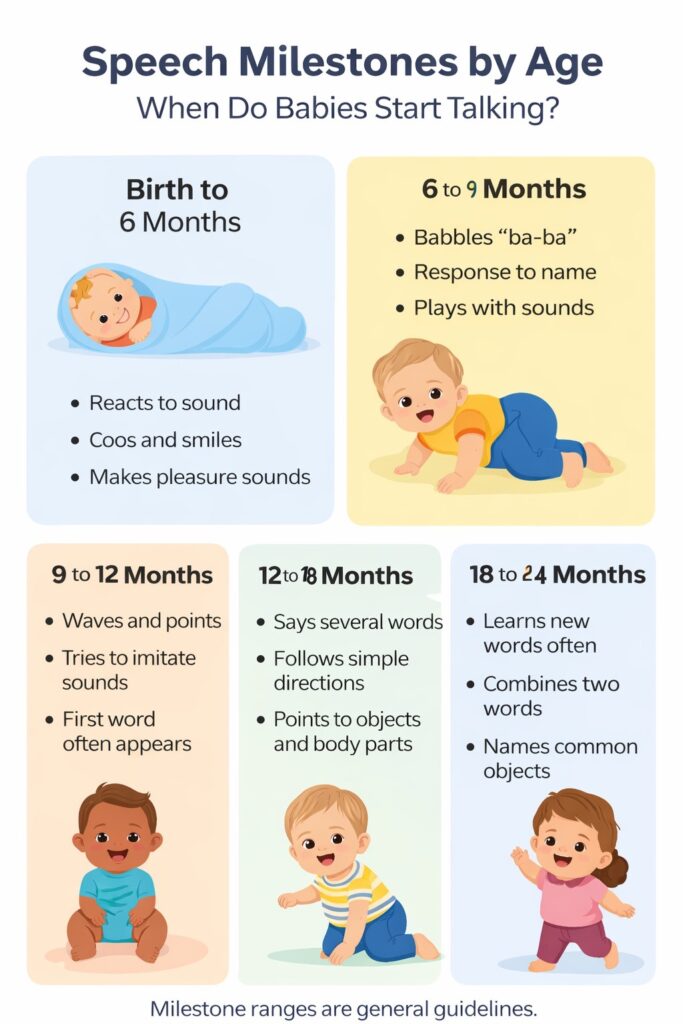
- Startles or quiets to sound
- Calms to a familiar voice
- Smiles during interaction
- Makes cooing and pleasure sounds
- Different cries for different needs
- Hearing and listening are developing
- Social connection is forming
- Voice control is beginning
- Back-and-forth rhythm is emerging
- Repeated syllables like “ba-ba” or “ma-ma”
- Squeals, growls, and playful sound changes
- Response to own name
- Interest in familiar voices and routines
- Turns toward sounds in the environment
- Mouth is practicing word-like movements
- Child is tuning in to language around them
- Social awareness is growing
- Sound variety signals healthy development
- Pointing or reaching for wanted objects
- Waving bye-bye
- Understanding simple words
- Imitating sounds more deliberately
- First word may appear near 12 months
- Intentional communication is developing
- Gestures show language is coming
- Comprehension is ahead of production
- Social referencing is active
- Several clear words emerging
- Frequent imitation of words
- Following simple one-step directions
- Pointing to body parts or objects
- Using sounds, words, and gestures together
- Expressive vocabulary is building
- Comprehension is strengthening
- Child is connecting words to meaning
- Communication is becoming purposeful
- Using several words regularly
- Naming people and common objects
- Understanding simple questions
- Trying to copy new words
- Two-word phrases like “more juice” or “daddy home”
- Vocabulary is expanding quickly
- Grammar is beginning to emerge
- Child is using language functionally
- Two-word combos signal a big leap forward
- Short phrases and simple sentences
- Asking for things with words
- Answering simple questions
- Following two-step directions
- Talking during play
- Understood more often by familiar adults
- Grammar is developing quickly
- Language is becoming a tool for thinking
- Social use of language is growing
- Speech clarity is improving steadily
When Should Parents Worry About Late Talking?
This is the part many parents want answered clearly. The honest answer is that you do not need to wait until a child is significantly behind before asking questions. Asking early is always better than waiting and worrying. The signs below are organized by age — if you notice several of them at any stage, an evaluation is a reasonable and helpful next step.
- Not babbling much or making varied sounds
- Not using gestures such as pointing, reaching, or waving
- Not responding to their name consistently
- Limited interest in people or interaction
- No real words used consistently with meaning
- Little or no imitation of sounds or words
- Poor understanding of simple, familiar language
- Fewer than about 50 words
- Not combining two words into short phrases
- Difficulty with back-and-forth interaction
- Trouble understanding simple directions
- Loss of words or communication skills previously present
- Poor or inconsistent response to sound
- Limited eye contact or social interest
- Very little attempt to communicate in any way
A child does not need to show every sign on this list to benefit from support. Even one or two concerns can be enough reason to ask questions. An evaluation gives you clarity — and if help is needed, a clear path forward.
In some children, late talking may be related to developmental language delay — a condition that responds well to early support.
Is It Normal for a Child to Understand but Not Talk?
Yes — this pattern is one of the most common situations families describe. A toddler who clearly follows directions, points to what they want, and responds to questions, yet says very few words. This gap between understanding language and producing it has a name: expressive language delay.
Understanding language and speaking it develop on separate tracks. Strong receptive skills alongside limited expressive output can be a reassuring sign — it means language comprehension is in place. But it does not mean everything is fine on its own.
- Follows one-step directions
- Points to named pictures or objects
- Responds to their name
- Understands simple questions
- Recognizes familiar people and routines
- Few or no clear words
- Relies heavily on gestures
- Rarely imitates sounds or words
- Does not use words to request things
- Frustrated when trying to communicate
A child who understands well but uses very few words may still be a late talker and may still benefit from speech and language support. Understanding is important — but so is being able to express wants, ideas, and feelings.
For a deeper look at this specific pattern, our guide My 2 Year Old Isn’t Talking But Understands explains what this means and what to do next.
Why Some Children Talk Later Than Others
There is not always one clear reason. Speech and language development can be shaped by many factors — and in most cases, several combine to influence when a child begins talking. Understanding the most common causes can help parents know what questions to ask.
Late Talker or Language Delay — What Is the Difference?
These two terms are often used interchangeably, but they are not always the same thing. Understanding the difference can help parents know what kind of support their child may need.
- Fewer words than expected for age
- Understands language fairly well
- Developing typically in other areas
- No clear underlying cause identified
- Some catch up without intervention
- Others benefit from early support
- Difficulty with both understanding and use
- May affect receptive and expressive skills
- Often broader than word count alone
- May have an identifiable contributing cause
- Usually benefits from professional support
- Earlier help typically leads to better outcomes
For a detailed breakdown of how these two patterns differ in practice, see our guide to late talker vs. speech delay — and what each means for next steps.
If you are concerned about delayed speech, speech therapy for toddlers can provide early support and practical guidance tailored to your child’s specific needs.
What Parents Can Do to Encourage Talking
Parents are the single most powerful influence on early language development — more than any program, app, or toy. The strategies that make the biggest difference are simple, free, and work inside your everyday routine. You do not need flashcards, drills, or constant testing. What helps most is warm, repeated, everyday interaction.
In my years working in early intervention, the children who made the greatest gains were almost always those whose parents actively used these strategies at home between sessions.
-
1Follow your child’s lead Notice what your child is looking at, reaching for, or enjoying — then talk about that moment. If they are rolling a ball, say “ball,” “roll ball,” or “my turn.” Simple language connected to real action works far better than drills.
-
2Use short, clear phrases Toddlers learn from language they can take in easily. Instead of “Would you like to go get your shoes because we are leaving now?” try “Shoes on” or “Time to go.” One step at a time sticks better.
-
3Repeat important words in context Children need to hear words many times in meaningful situations. During snack: “banana,” “more banana,” “eat banana,” “banana all gone.” Repetition inside real moments helps words stick.
-
4Pause and wait After speaking to your child, pause for 5–10 seconds before continuing. Many adults fill every silence — but that waiting time gives a child space to think, look, gesture, or attempt a word. It can make a real difference.
-
5Expand what your child says If your child says “car,” respond with “big car,” “blue car,” or “car go.” Expanding one word into a short phrase models the next step without pressure or correction.
-
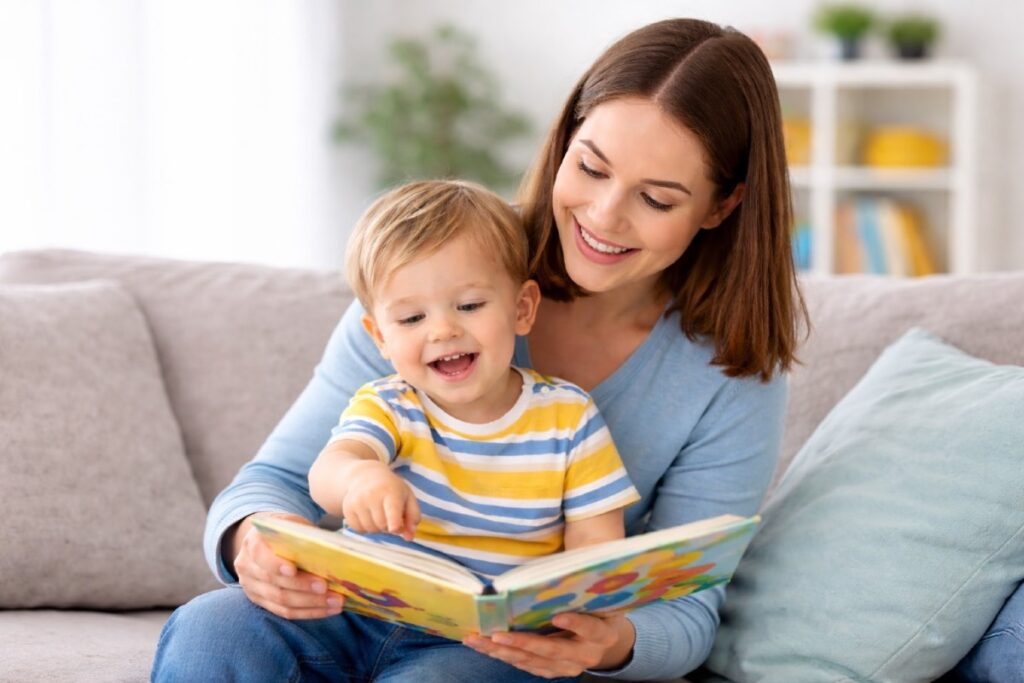
6Read simple books together every day Books with clear pictures and repeated words support language growth. Point, label, pause, and let your child join in however they can. The goal is not reading every word — it is interaction.
-
7Sing songs and use gestures Songs with actions and finger plays are excellent for early communication. Music slows language down and makes words easier to notice, remember, and imitate.
-
8Limit passive screen time Children learn language from people, not screens. Talking, playing, singing, and shared routines are far more effective than passive viewing — especially under age two.
Signs That a Child Is Making Good Progress
Even when speech is not fully there yet, these signs are encouraging. Progress does not have to be dramatic — it just needs to be moving forward consistently.
When to Seek a Speech Evaluation
Parents often ask whether they should wait a little longer. In most cases, it is better to ask early rather than wait and worry. An evaluation does not automatically mean something is seriously wrong — it simply gives you clearer information and, if needed, a plan.
- ✓ Is not saying words near the expected age
- ✓ Seems frustrated when trying to communicate
- ✓ Does not understand as much as expected
- ✓ Has lost words or skills they previously had
- ✓ Is not pointing or using gestures to communicate
- ✓ Something just does not feel right — trust that instinct
Does Waiting Hurt?
Sometimes people tell parents “he’ll talk when he’s ready” or “her brother was late too.” That advice can feel comforting, but it can also delay help that makes a real difference. Some children do catch up on their own. Others need support — and make better progress when help begins early. Waiting too long can mean missing a valuable window for language growth.
It is usually better to check than to guess. Understanding the difference between a late talker and a speech delay can help parents decide on their next step with more confidence.
What About Early Intervention?
Early intervention is a publicly funded program available in every US state that provides speech therapy and developmental support for children from birth to age three. There is no cost to families for the evaluation, and therapy costs are typically covered or significantly reduced.
You do not need a referral from a doctor — you can self-refer directly at any time.
- Search “[your state] early intervention program” to find your local contact
- Ask your pediatrician for a referral at your child’s next well-child visit
- Request an evaluation in writing — programs are required to respond within a set timeframe
- The evaluation is free and does not commit you to any therapy
For a full overview of what early intervention involves, see our guide to early intervention speech therapy — including how evaluations work and how parents are involved throughout.
Frequently Asked Questions
Still have questions about your child’s speech?
Whether you are looking for reassurance, a speech therapist near you, or a clearer picture of where your child stands — we are here to help.
If you have concerns about your child’s development, please consult a qualified speech-language pathologist or your child’s pediatrician.
© 2026 Burke Networks · Editorial Policy