
SpeechTherapy.org › Disorders › Children
Toddler Development

Late Talker vs Autism: A Speech Therapist Explains the Real Difference
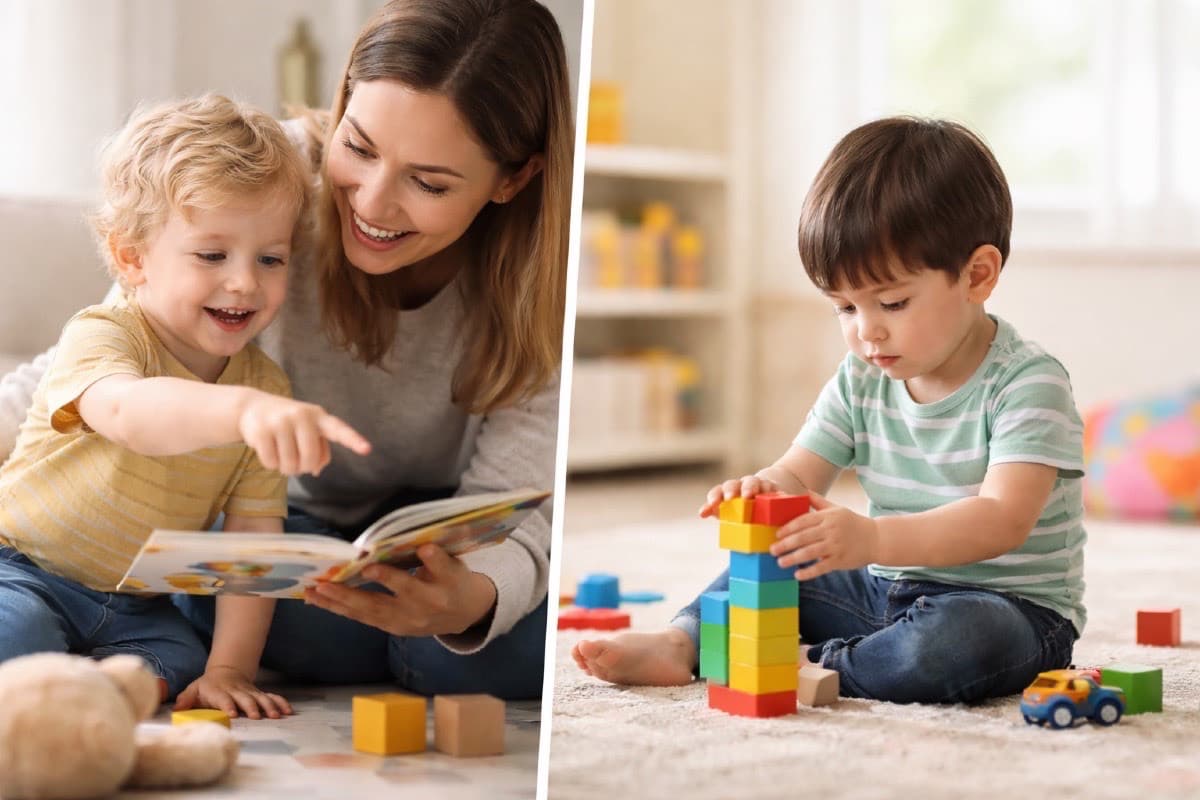
Parent and toddler playing together on the floor — exploring late talker vs autism differences.

Your toddler is not talking as much as other children. Someone mentions autism. Your stomach drops. Here is what a speech-language pathologist actually looks at — and why the answer is not as simple as a word count.

Key takeaways
  • Speech delay alone does not indicate autism — most late talkers are not autistic
  • The critical difference is social connection, not the number of words
  • A late talker wants to communicate but struggles to produce words — social skills are intact
  • Autism involves broader differences in how a child shares attention and engages with people
  • Both conditions respond well to early support — waiting is rarely the right choice
  • A professional evaluation is the only reliable way to distinguish between the two
On this page
  1. What is a late talker?
  2. What is autism spectrum disorder?
  3. Why parents confuse the two
  4. 7 key differences — side by side
  5. Red flags that suggest autism
  6. How professionals evaluate the difference
  7. What therapy looks like for each
  8. When to seek help and how to access it
  9. FAQ

Late talker vs autism is one of the most searched — and most anxiety-provoking — questions parents bring to me. And it makes sense. The overlap is real. Both involve limited speech. Both can look similar at a glance. And the stakes feel enormous.

But here is what 28 years of clinical work has taught me: the difference between a late talker and a child with autism is not primarily about words. It is about connection. And once you know what to look for, the picture becomes considerably clearer.

This guide walks you through exactly what professionals look at — so you can stop guessing and start getting answers.


What Is a Late Talker?

A late talker is a toddler — typically between 18 and 30 months — who has fewer spoken words than expected for their age but is developing typically in every other area. The defining feature is not what is missing. It is what is present.

Late talkers are social. They want to connect. They show you things, bring you things, look at you when something is funny or surprising. They just struggle to get the words out.

What is present — the encouraging picture
  • Strong, natural eye contact
  • Points to share interest with others
  • Responds consistently to their name
  • Seeks comfort from familiar adults
  • Engages in back-and-forth play
  • Imitates actions and gestures
  • Shows clear emotional responses
  • Understands much more than they say
  • Emerging pretend play
What is delayed — the area of concern
  • Fewer spoken words than expected
  • Not yet combining two words
  • High reliance on pointing and gestures
  • Frustration when not understood
  • May not imitate words readily
The late talker wants to connect. They attempt to communicate in every way available to them. Words are delayed — but the desire and the social drive to communicate is unmistakably there.

Many late talkers catch up by age three. Others benefit significantly from early speech therapy, which accelerates vocabulary growth and helps bridge the gap before it widens. For a full breakdown of what this pattern looks like and how it differs from other delays, see our guide to late talker vs speech delay.


What Is Autism Spectrum Disorder?

Autism Spectrum Disorder (ASD) is a neurodevelopmental condition that affects how a person communicates, connects socially, and experiences the world around them. It is called a spectrum because it presents very differently from one person to the next — ranging from subtle social differences to significant communication and behavioral challenges.

Speech delay can be part of autism — but it is not the defining feature. The defining features of autism involve the quality of social engagement and communication, not word count alone.

Social communication
  • Reduced or inconsistent eye contact
  • Limited pointing to share interest
  • Difficulty with back-and-forth exchange
  • Limited sharing of enjoyment
  • May not respond to name reliably
Social interaction
  • Preference for solitary play
  • Limited interest in peers
  • Difficulty reading social cues
  • Reduced imitation of others
  • Limited joint attention
Repetitive behaviors
  • Hand flapping, rocking, spinning
  • Lining up or sorting objects
  • Strong insistence on routines
  • Intense, narrow interests
  • Repetitive use of language
Sensory differences
  • Heightened sensitivity to sounds
  • Unusual reactions to textures
  • Reduced sensitivity to pain
  • Visual or movement seeking
  • Difficulty with sensory transitions
Important — autism presents on a wide spectrum Some autistic children speak early and speak well. Some are highly verbal but struggle with the social use of language. Others have significant speech and language delays. Not every autistic child will show all of these features — and the presence of one or two does not confirm a diagnosis. That is why professional evaluation matters.
A note from clinical practice When I evaluate a toddler for possible autism, I am not counting words. I am watching how the child shares their experience — whether they look to show me something exciting, whether they check my face when something unexpected happens, whether they reach toward connection in any way. Those moments tell me far more than the word count ever could.

Early identification of autism matters enormously. Research consistently shows that children who receive support in the early years make significantly more progress than those who start later. If you are seeing signs that concern you, an evaluation is the right next step — not because a diagnosis is certain, but because clarity is always better than uncertainty.

Why Parents Confuse the Two

The confusion is understandable — and it is not a failure of observation. Early signs of late talking and autism do overlap in ways that genuinely make them hard to distinguish without clinical training.

Where the overlap creates confusion
Signs seen in both
  • Fewer words than peers
  • Difficulty combining words
  • Heavy reliance on pointing
  • Frustration when misunderstood
  • Needing communication support
  • Standing out at playgroups
What makes the difference
  • Quality of eye contact
  • Pointing to share — not just to request
  • Response to their name
  • Interest in other children
  • Imitation of people
  • Presence of repetitive behaviors

Online searching makes this harder, not easier. Search results about speech delay routinely surface autism. That exposure, combined with the natural anxiety of parenting, leads many parents to assume the worst when they see a child who is not talking. The reality is that speech delay is far more commonly caused by other factors — expressive language delay, hearing differences, or simply a late talker pattern.

Speech delay alone does not define autism. The core difference lies in social communication — in how a child shares attention, experience, and emotion with the people around them.

Understanding that distinction is what reduces unnecessary panic while still encouraging the right action when it is genuinely needed.


Late Talker vs Autism: 7 Key Differences

Below is the side-by-side comparison that parents consistently tell me is the most useful thing they have seen. Read across each row — the pattern, taken as a whole, tells the story.

Feature ✓ Late Talker ⚑ Autism
Eye Contact Strong and natural — child looks to connect Reduced, inconsistent, or used differently
Pointing Points to share interest (“look at that!”) and to request May only point to request, or not point at all
Social Interest Seeks interaction, enjoys people, wants connection May prefer solitary activity, limited peer interest
Imitation Imitates sounds, words, and actions readily Limited imitation of people and actions
Name Response Responds consistently when name is called May not respond or responds inconsistently
Joint Attention Checks your face, shares focus easily Limited shared attention with others
Pretend Play Emerging pretend play present Limited, absent, or unusual pretend play
Gestures Uses many gestures to communicate Few gestures, or unusual gesture use
Repetitive Behavior Typical range of toddler behavior Repetitive movements or rituals present
Sensory Responses Typical reactions to the environment Heightened or reduced sensory sensitivity

No single row is diagnostic. The pattern across rows is what matters.

The Core Distinction

💬
Late Talker
Wants to connect. Struggles to find the words. The desire to communicate is clearly present — the output is delayed.
🔄
Autism
May struggle with connection itself — sharing attention, reading social cues, and engaging in reciprocal exchange.

That distinction — between struggling to find words and struggling with connection — matters more than the total number of words spoken. It is the starting point for any good clinical evaluation.


Signs That Suggest Your Child May Be a Late Talker

If you are seeing a pattern of strong social engagement alongside limited speech, that is an encouraging picture — and one consistent with a late talker rather than autism. These are the signs that point in that direction.

Signs more consistent with late talking than autism
Makes strong, natural eye contact
Points to share things they find exciting
Responds reliably when name is called
Brings toys to show you
Seeks comfort from familiar adults
Engages in pretend play
Imitates actions and sounds
Understands far more than they say
Shows clear frustration at not being understood
Interested in other children

These signs do not rule out autism entirely — and they do not mean evaluation is unnecessary. But they are genuinely reassuring, and they are the picture most parents of late talkers describe when they come in. See our full guide to late talker vs speech delay for a deeper look at how this pattern is assessed.


Red Flags That Suggest an Autism Evaluation Is Needed

No single sign below confirms autism — and some autistic children show none of these clearly in early toddlerhood. But if you are seeing several of these in combination, it is time to request an evaluation rather than continue monitoring from the sidelines.

Request an evaluation if you are seeing:
  • !
    No pointing by 12–15 months Pointing to share interest — not just to request — is one of the earliest and most reliable social communication markers.
  • !
    Inconsistent or absent response to name A child who does not reliably turn when called — especially in a quiet environment — warrants closer attention.
  • !
    Limited or reduced eye contact Occasional avoidance is normal. A consistent pattern of limited eye contact during social interaction is worth noting.
  • !
    Loss of previously used words or skills Regression — losing words or social behaviors a child previously demonstrated — should always prompt immediate evaluation.
  • !
    Repetitive movements or routines Hand flapping, spinning, rocking, lining up objects, or strong resistance to changes in routine beyond typical toddler behavior.
  • !
    Little interest in sharing enjoyment A child who does not look to share excitement — who sees something funny or surprising and does not check your face — is missing a key social milestone.
  • !
    Minimal imitation Toddlers learn language and social behavior through imitation. A child who rarely copies sounds, words, or actions is missing a foundational learning route.
  • !
    Unusual sensory reactions Extreme distress at ordinary sounds, textures, or lights — or the opposite, reduced sensitivity to pain or temperature — can be part of an autism profile.
Act immediately, regardless of age, if:

Your child has lost words or social skills they previously had. Regression at any age warrants an evaluation without delay.

From clinical practice One sign in isolation rarely tells you much. What matters is the pattern — how many of these you are seeing, how consistently, and across how many different settings. If your gut is telling you something is different about how your child connects with people, that instinct deserves to be taken seriously. Not because autism is certain, but because early clarity is always better than prolonged uncertainty.

How Professionals Evaluate the Difference

One of the most common questions parents ask me is: “What actually happens at an evaluation?” The process is observational, interactive, and far less clinical than most people expect. There are no right or wrong answers. There is no pressure on the child. And the goal is always clarity — not a label.

Here is how a thorough evaluation typically unfolds when the question is late talker vs autism.

1
Developmental history and parent interview The evaluation always begins with you. The clinician asks about your child’s development from birth — when they babbled, when they pointed, what they understood, how they played, what changed and when. This history is often as informative as anything observed in the room.
2
Standardized speech and language assessment A speech-language pathologist assesses receptive language (what the child understands), expressive language (what they say), social communication, play skills, and gesture use. Formal tools give a standardized picture of where the child stands relative to their age.
3
Autism screening tools Questionnaires like the M-CHAT-R/F identify social communication patterns associated with autism. Pediatricians use these routinely at 18- and 24-month well visits. A positive screen doesn’t confirm autism — it flags that a diagnostic evaluation is warranted.
4
Play-based observation The most revealing part of any evaluation happens during unstructured play. The clinician watches how the child shares attention, seeks interaction, responds to social bids, uses gestures, and engages in pretend play. These natural moments tell the story that no test can fully capture.
5
Hearing screening Any evaluation for speech or language delay should include a hearing check. Even mild or fluctuating hearing loss can significantly impact speech production and must be ruled out before drawing conclusions about development.
6
Diagnostic evaluation for autism (if indicated) When the assessment points toward possible autism, a full diagnostic evaluation is the next step. This is typically conducted by a developmental pediatrician, neuropsychologist, or multidisciplinary team using gold-standard tools such as the ADOS-2. This is a separate, more in-depth process from a speech evaluation.

What Clinicians Specifically Observe

👁️
Eye contact quality Not just presence — but how it is used socially and whether it shifts during conversation
👆
Pointing behavior Declarative pointing (to share) vs. imperative pointing (to request) — a key early distinction
🔄
Joint attention Does the child follow a point? Look where you look? Check your face for your reaction?
🪞
Imitation Does the child copy sounds, words, actions? Imitation is the engine of early language learning
🧸
Play quality Exploratory vs. functional vs. pretend play — and whether play is social or solitary
🔁
Repetitive patterns Unusual movements, routines, or use of objects beyond typical toddler behavior
What evaluation is — and is not Evaluation is observation, not interrogation. A skilled clinician is watching natural behavior in a comfortable, play-based environment. They are not looking to confirm a worst case — they are looking for clarity. Whatever the outcome, you leave with answers and a direction. That is always better than waiting and wondering.

What Therapy Looks Like — Late Talker vs Autism

Both conditions respond well to early support — but the approach differs meaningfully. Understanding what therapy targets for each gives parents a realistic picture of what to expect and why starting early matters so much.

Speech therapy for late talkers
  • Building expressive vocabulary
  • Moving from single words to two-word phrases
  • Strengthening imitation of sounds and words
  • Increasing communication attempts
  • Reducing frustration during communication
  • Coaching parents in language-rich strategies
  • Play-based, child-led sessions
  • Parent is in the room throughout
Speech therapy for autism
  • Building joint attention skills
  • Strengthening social reciprocity
  • Developing functional communication
  • Introducing augmentative communication (AAC) where appropriate
  • Supporting flexible play and pretend play
  • Building imitation as a foundation
  • Connection first — language follows
  • Highly individualized to the child’s profile
What both approaches share: Sessions are play-based, not drill-based. Parents are active participants. Goals are measured and adjusted regularly. And the earlier support begins, the more responsive the child’s developing brain tends to be.

For a detailed look at what toddler speech therapy looks like in practice, see our guide to toddler speech therapy. For autism-specific support, see our overview of speech therapy for autism.


When to Seek Help — and Which Kind

The honest answer to “should I wait?” is almost always: no. The window from birth to age three is the most responsive period for language and social development. Acting early — even when you are not certain — is always preferable to discovering at age four that earlier support would have helped.

Request a speech evaluation if:
  • No words by 18 months
  • Fewer than 50 words by age two
  • No two-word combinations by 24 months
  • Words are present but not growing
  • Your child is highly frustrated communicating
  • Your pediatrician has expressed concern
  • Something feels off — even if you can’t name it
Request an autism evaluation if:
  • No pointing by 15 months
  • Not responding to name by 12 months
  • Limited or no eye contact
  • Loss of previously used words or skills
  • Repetitive movements or strong routines
  • Little interest in people or interaction
  • Positive M-CHAT-R/F screen at pediatrician

These are not mutually exclusive. Many children benefit from a speech evaluation and an autism screening at the same time — and a good speech-language pathologist will flag concerns that warrant a broader developmental evaluation during the assessment.

Accessing Early Intervention if Your Child Is Under Three

Early Intervention is a federally funded program available in every US state that provides free evaluations and low or no cost services for children with developmental delays from birth to age three. You do not need a doctor’s referral — you can contact the program directly.

How to access early intervention for your toddler

You can self-refer at any time. No diagnosis is required to request an evaluation.

  • Search “[your state] early intervention program” or use the CDC state directory below
  • Call and request a free developmental evaluation for your child
  • The program is required to respond within a set timeframe
  • The evaluation is completely free and carries no commitment to therapy
  • If your child qualifies, services are provided at little or no cost, often in your home
  • Both speech delay and autism concerns are appropriate reasons to refer
Find your state’s Early Intervention program: CDC Early Intervention State Directory →

For a complete overview of how Early Intervention works — including what to expect at the evaluation and how therapy is delivered — see our guide to early intervention speech therapy.

🧭

Trust your instincts

Parents who seek evaluation early are not overreacting. They are paying attention. If something feels different about how your child connects with people, that instinct deserves to be taken seriously — not dismissed. Early clarity is always better than prolonged uncertainty. You are not looking for a diagnosis. You are looking for answers.

A note from clinical practice In 28 years I have never had a parent tell me they regret finding out early. I have had many tell me they wish they had not waited. If you can reach evaluation rather than monitoring from a distance, do it. Whatever the outcome, you will leave with clarity — and clarity is where progress begins.

Ready to find a speech therapist near you? Use our find a speech therapist directory to search by location and specialty. Many qualified SLPs now offer teletherapy — a strong option if local wait times are long.

Frequently Asked Questions

Is every late talker autistic?
No — and this is one of the most important things to understand. The majority of late talkers are not autistic. Many have expressive language delay or simply sit at the slower end of typical development and catch up with time or early support. Speech delay is one possible sign of autism, but it is far more commonly caused by other factors. The distinction lies in social communication — not in word count alone.
Can a child have both speech delay and autism?
Yes. Some autistic children also experience significant expressive language delay — they may say very few words, or in some cases none at all. The two are not mutually exclusive. A child can have autism and also be a late talker. This is one reason why a thorough evaluation looks at the full picture — social communication, play, sensory responses, and language — rather than focusing on word count alone.
My child makes good eye contact. Does that rule out autism?
Strong eye contact is genuinely encouraging and makes autism less likely — but it does not rule it out entirely. Autism presents on a wide spectrum, and some autistic children do make reasonable eye contact, particularly in familiar settings with familiar people. What clinicians look at is the quality and purpose of eye contact — whether it is used for social sharing, whether it shifts naturally during conversation, and how it fits into the broader picture of the child’s communication. One strong sign in isolation is reassuring, but it is not conclusive either way.
What is the most important early sign that distinguishes late talking from autism?
Joint attention — specifically, declarative pointing. A child who points to share something interesting (“Look at that dog!”) and then checks your face to share the moment with you is demonstrating a sophisticated social communication skill that is a key early marker distinguishing late talking from autism. Late talkers typically point. Children with autism may point to request things but show limited or absent pointing to share interest. If your child points and checks your face, that is a meaningful encouraging sign. If pointing is absent by 14–15 months, that warrants attention regardless of word count.
Should I wait and see, or seek evaluation now?
Seek evaluation now. The wait-and-see approach is well-intentioned but rarely serves children well. Age two to three is the most responsive window for language and social development. Early Intervention services are available from birth to age three in every US state at no cost to families — but only while your child is under three. Waiting until age three may mean missing both the most critical developmental window and the free services that come with it. An evaluation at age two costs you nothing and gives you answers. Whatever the outcome, you leave with clarity and a direction.
How many words should a toddler say before autism is a concern?
Word count is not the primary indicator for autism — social communication is. A child can have very few words and not be autistic. A child can have many words and still show the social communication differences associated with autism. The milestones that matter most for identifying autism concerns are: pointing by 12–14 months, responding to name by 12 months, and showing joint attention — looking to share interest with others. For word count milestones, most children say their first words by 12 months, have around 50 words by 24 months, and begin combining words by 18–24 months. See our guide to when children should start talking for a complete milestone breakdown.
Does speech therapy help children with autism?
Yes — significantly, and especially when started early. Speech therapy for autism focuses on building the social communication foundations that language grows from: joint attention, imitation, turn-taking, and functional communication. For children who are minimally verbal, augmentative and alternative communication (AAC) — including picture boards and speech-generating devices — can be transformative. Research consistently shows that early, intensive speech therapy improves communication outcomes for autistic children regardless of where they fall on the spectrum. Connection is built first, and language follows.
Will my late talker catch up without therapy?
Some will, and some will not — and at age two it is genuinely difficult to predict which group your child falls into. Research shows roughly half of late talkers catch up by age three without formal intervention. The other half go on to have persistent language differences that respond much better to early support than to waiting. The encouraging signs — strong comprehension, good social skills, active pointing — are associated with better catch-up outcomes. But they are not a guarantee. An evaluation at age two gives you a much clearer picture than watching and hoping. For more on this, see our guide to toddler speech therapy.
How do I access Early Intervention for my toddler?
You do not need a referral from your pediatrician. You can self-refer directly. Search “[your state] early intervention program” to find your local contact, or use the CDC Early Intervention state directory. Call and request a free developmental evaluation — programs are required to respond within a set timeframe. The evaluation is completely free and does not commit you to therapy. If your child qualifies, services are provided at little or no cost, often in your home. Both speech delay and autism concerns are entirely appropriate reasons to refer. For everything you need to know, see our guide to early intervention speech therapy.
How do I find a speech therapist who has experience with late talkers and autism?
Start with Early Intervention if your child is under three — it is free, requires no referral, and connects you with therapists experienced in early childhood. If you prefer private evaluation, ask your pediatrician for a referral to a speech-language pathologist with early childhood or autism experience, or use our find a speech therapist directory to search by location and specialty. Many qualified SLPs now offer teletherapy, which can significantly reduce wait times and is often equally effective for toddler language work.

Related Reading


Ready to take the next step?

Whether you want to find a speech therapist, understand Early Intervention, or get a clearer picture of where your child stands — help is closer than you think.

This article is intended for informational purposes only and does not constitute medical or clinical advice.
If you have concerns about your child’s development, please consult a qualified speech-language pathologist or your child’s pediatrician.
© 2026 Burke Networks · Editorial Policy
About the Author
JB
John Burke, MA, CCC-SLP
Speech-Language Pathologist · ASHA Life Member · Founder, SpeechTherapy.org

John Burke is a speech-language pathologist with more than 28 years of clinical experience supporting children and adults with communication, language, and swallowing challenges. During the final decade of his clinical career he focused primarily on early intervention — working with children from birth to age three — which directly shapes the guidance on this site. He founded SpeechTherapy.org to help families access clear, reliable information without needing a medical background to understand it.

MA, CCC-SLP ASHA Life Member Early Intervention Specialist 28 Years Clinical Experience
This article reflects John Burke’s clinical expertise and professional experience. It was drafted with AI assistance and reviewed and approved by the author. It is intended for informational purposes only and does not constitute medical advice. If you have concerns about your child’s development, please consult a qualified speech-language pathologist or your child’s pediatrician.
Scroll to Top