
Music and Early Speech Development: How Songs Help Children Talk
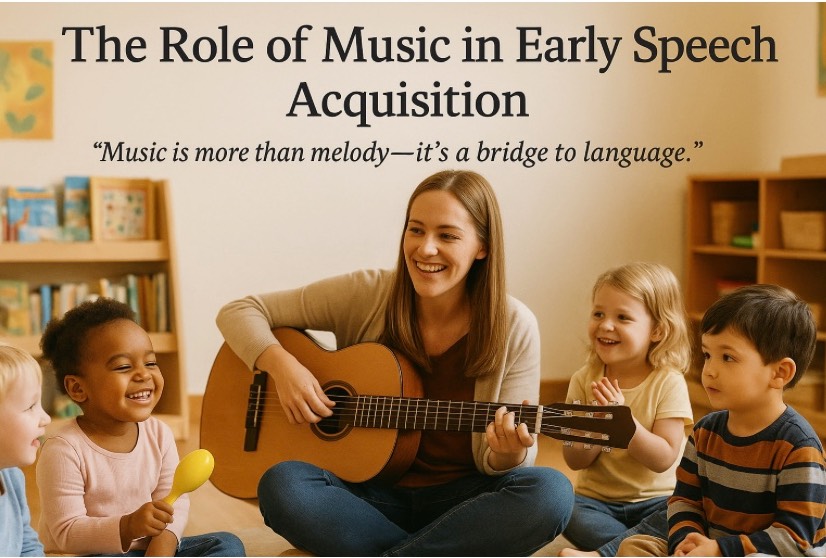
Introduction
Many parents notice their child sings before speaking clearly. Others see their toddler light up during favorite songs. Research and clinical experience both show that music and early speech development are closely connected.
Songs build listening, rhythm, memory, imitation, and emotional engagement — all foundations for spoken language. When used intentionally, music becomes a powerful tool for supporting early communication.
This guide explains how music supports speech, why rhythm strengthens the language brain, and simple ways families can use songs to encourage early words.
How Music Supports Early Speech Development
Music strengthens several skills that directly support communication:
- Auditory attention
- Turn-taking
- Imitation
- Memory for sequences
- Emotional connection
Speech is patterned. Words have rhythm. Sentences have timing. Music makes those patterns easier to hear and reproduce.
Children often produce sung words before they can say them conversationally because melody and rhythm provide structure.
For a broader look at typical development, see our guide to speech and language milestones by age.
Why Rhythm Matters for the Language Brain
Rhythm organizes sound in time.
When a child claps, bounces, or sways to music, the brain coordinates movement with sound timing. This supports:
- Syllable awareness
- Speech timing
- Word segmentation
- Breath control
Rhythm and language share overlapping neural pathways. That is one reason music can feel like a natural bridge to speech.
Music does not replace therapy when needed — but it prepares the brain for communication.
Using Songs to Encourage First Words
Songs create repetition without pressure.
Simple action songs such as:
- Wheels on the Bus
- If You’re Happy and You Know It
- Old MacDonald
encourage children to:
- Anticipate missing words
- Fill in predictable endings
- Imitate gestures and sounds
Try pausing before a key word:
“The wheels on the bus go round and ___.”
Pause. Smile. Wait.
That pause invites participation.
If your child is just beginning to vocalize, accept sounds, gestures, or eye contact as meaningful responses.
You may also explore our page on baby’s first words for additional strategies.
Music for Late Talkers and Speech Delay
Children with speech delay often respond especially well to music because it increases engagement and lowers pressure.
Music can help:
- Increase vocal play
- Strengthen joint attention
- Encourage imitation
- Expand expressive vocabulary
If your toddler has limited words, you may want to review signs of speech delay at 18 months or learn about early intervention speech therapy services available in your state.
Early support makes a difference.
Practical Music Activities for Toddlers
You do not need musical training to use music effectively.
Try:
Daily Routine Songs
Sing during diaper changes, bath time, or snack time.
Movement Songs
Add clapping or bouncing to match syllables.
Name Songs
Insert your child’s name into familiar tunes.
Pause and Wait
Stop mid-song and allow time for response.
Keep songs short. Keep them repetitive. Keep them joyful.
Consistency builds confidence.
When to Seek Professional Support
Music supports development, but it does not replace evaluation when concerns are present.
Consider a speech evaluation if your child:
- Has few or no words by 18 months
- Does not imitate sounds
- Has difficulty understanding simple directions
- Shows limited social engagement
Learn more about speech therapy for toddlers (ages 0–3) and how early intervention can help.
The Power of Music and Connection
Music builds more than words.
When you sing with a child, you create shared attention, predictable interaction, and emotional connection. Those moments form the foundation for communication.
Music and early speech development work together because both depend on rhythm, repetition, and engagement.
Simple songs. Shared smiles. Repeated patterns.
That is how speech begins.
Does music really help speech development?
Yes. Music strengthens rhythm, memory, imitation, and engagement — all foundational skills for early speech.
What songs are best for toddlers learning to talk?
Repetitive action songs with predictable phrases work best.
Can music help a child with speech delay?
Music can increase participation and vocalization, but children with delays may still benefit from professional evaluation.