
Augmentative and Alternative Communication (AAC): Devices, Apps and Communication Support
Communication does not always have to happen through spoken words. Augmentative and alternative communication, often shortened to AAC, includes many different ways children and adults can express what they want to say when speech alone is difficult, unreliable, tiring, or unavailable.
AAC can be as simple as pointing, gesturing, writing a word, or choosing a picture on a communication board. It can also include sophisticated AAC apps and speech-generating devices that allow someone to select symbols, type messages, or use alternative access methods such as switches or eye gaze to produce spoken communication.
Some people use AAC as their primary way of communicating. Others use it alongside speech when they are not understood, when speaking takes too much effort, or when their communication abilities change because of a developmental condition, injury, surgery, or progressive neurological disease. AAC can be appropriate for both children and adults, and a person does not need to stop speaking in order to use it.
This guide explains what AAC is, the differences between communication boards, apps and speech-generating devices, who may benefit from AAC, how systems are selected, and how speech-language pathologists help people and their families build communication that works in everyday life.
What Is Augmentative and Alternative Communication (AAC)?
AAC Can Add to Speech or Provide Another Way to Communicate
The word “augmentative” means adding to a person’s existing communication, while “alternative” refers to using another method when speech is not available or does not meet the person’s needs. In real life, those categories often overlap. Someone may talk during an easy conversation but use an AAC device to communicate a longer or more complicated message.
AAC is also broader than electronic technology. Facial expressions, gestures, pointing, sign language, written words, photographs, communication books, letter boards, picture boards, apps and speech-generating devices can all be part of an AAC system. Many people naturally combine several methods rather than depending on only one way to communicate.
The goal is not simply to make someone press buttons on a device. The goal is meaningful communication: asking questions, refusing something, telling a joke, sharing an opinion, talking about what happened that day, participating in school or work, making medical decisions, and connecting with other people.
AAC for Children
Children may benefit from AAC when spoken language is developing slowly, speech is difficult to understand, or a developmental or motor condition makes talking challenging. AAC may be considered for children with conditions such as autism, cerebral palsy, childhood apraxia of speech, genetic syndromes, developmental disabilities, and other communication needs.
Parents sometimes worry that introducing AAC means giving up on speech. AAC does not have to replace speech therapy or spoken language. A child can continue practicing speech while also having a reliable way to communicate thoughts and needs that may be difficult to express verbally. This can give the child access to communication while speech and language skills continue developing.
For young children especially, AAC should be about much more than requesting food or toys. Children need words for people, actions, feelings, questions, comments, social interaction and everyday experiences. A useful AAC system gives a child opportunities to communicate for many of the same reasons other children talk.
AAC for Adults
Adults may begin using AAC after a stroke, traumatic brain injury, laryngectomy, or other medical event that affects speech or language. AAC can also be helpful for people living with ALS, Parkinson’s disease, multiple sclerosis, progressive neurological conditions, dysarthria, apraxia, aphasia, or other communication disorders.
The type of AAC an adult needs can vary considerably. One person may only need a small card with frequently used phrases during periods when speech is difficult. Another may communicate primarily by typing into a speech-generating device. Someone with changing motor abilities may eventually need switch scanning or an eye-gaze system rather than direct touch.
Adults should remain active participants in decisions about their communication whenever possible. Vocabulary, voice, appearance, access method and technology should reflect the person’s preferences, routines, relationships and priorities rather than treating AAC as a one-size-fits-all medical device.
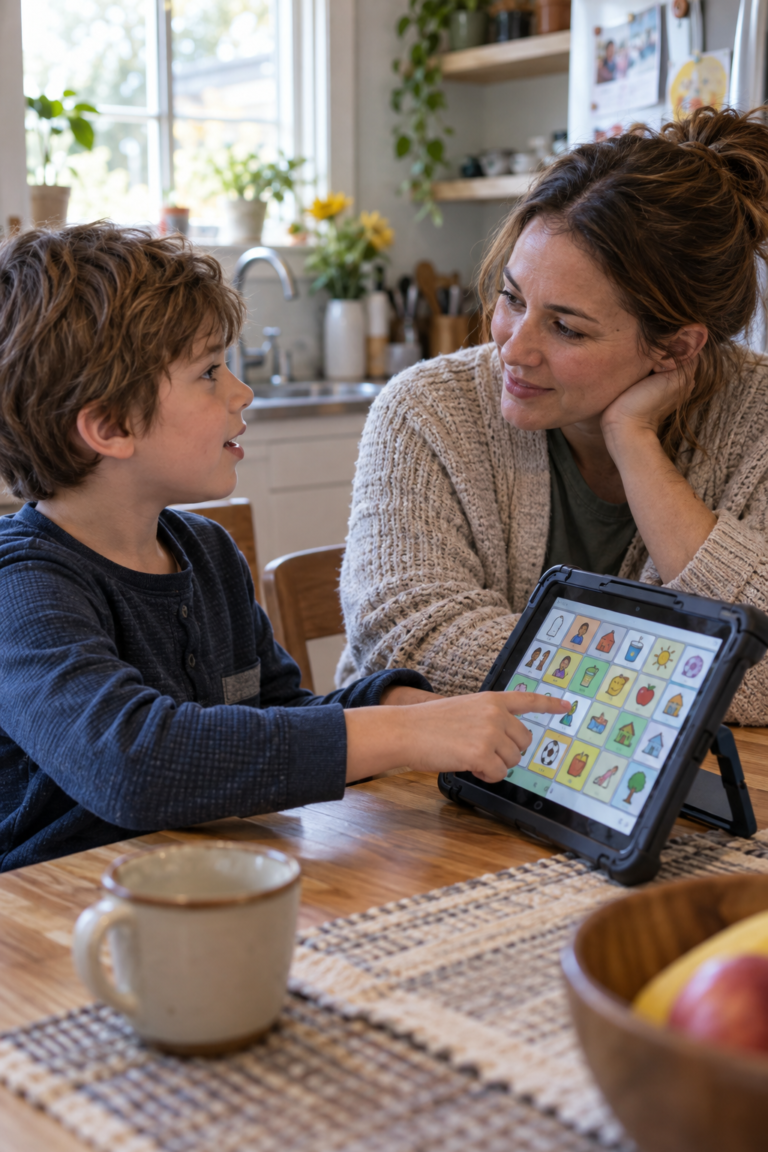
Types of AAC Devices, Apps and Communication Supports
Gestures, Communication Boards and Low-Tech AAC
AAC does not require an electronic device. Gestures, facial expressions, pointing, writing and manual signs are examples of unaided communication because the person does not need additional equipment. These methods can be fast and natural, although they may not always be understood by unfamiliar communication partners.
Low-tech AAC can include printed picture boards, communication books, alphabet boards, topic boards, yes-and-no cards, photographs and written choices. These tools can be especially useful when an electronic device is unavailable, charging, being repaired, difficult to use in a particular environment, or simply unnecessary for a short interaction.
Low-tech communication is not automatically a “beginner” stage that everyone must complete before using technology. Some people use low-tech and high-tech AAC together throughout their lives. A printed communication board may remain an important backup even when a person primarily uses a sophisticated speech-generating system.

AAC Apps and Speech-Generating Devices
High-tech AAC includes software and devices that produce spoken messages. Some systems use symbols or pictures that a person selects to build a message. Others rely mainly on typing and word prediction. Many systems combine symbols, spelling, stored phrases, personalized vocabulary and synthesized speech.
Families and adults researching AAC may encounter names such as Proloquo2Go, TD Snap, TouchChat, LAMP Words for Life, and communication systems from companies such as Lingraphica. These are examples rather than recommendations. AAC programs differ significantly in vocabulary organization, access options, language support, voices, customization, hardware and the amount of training required.
A consumer tablet running an AAC app and a dedicated speech-generating device may look similar, but they are not always interchangeable. Dedicated devices may offer specialized mounting, durability, speakers, switch or eye-gaze access, technical support and funding options. The appropriate choice depends on the individual rather than simply which app appears easiest during a brief demonstration.
Touch, Eye Gaze, Switches and Other Ways to Access AAC
Alternative access may include switches, scanning, head tracking, eye gaze, a mouse or joystick, keyguards, styluses, partner-assisted scanning or other adaptations. Someone with ALS, cerebral palsy, significant motor impairment, or another condition affecting movement may communicate very effectively even when directly touching a screen is difficult or impossible.
Access can also change over time. A person who initially uses direct touch may later need a different method, while another person may improve motor access with positioning or equipment changes. AAC assessment therefore looks at more than vocabulary. The person must be able to access the communication system comfortably and efficiently enough to use it in real situations.
Access can also change over time. A person who initially uses direct touch may later need a different method, while another person may improve motor access with positioning or equipment changes. AAC assessment therefore looks at more than vocabulary. The person must be able to access the communication system comfortably and efficiently enough to use it in real situations.
Choosing and Learning to Use an AAC System
What Happens During an AAC Evaluation?
An AAC evaluation looks at how a person communicates now and what makes communication easier or harder. A speech-language pathologist may explore speech, language comprehension, expressive language, reading and spelling when appropriate, as well as communication with familiar and unfamiliar partners across different settings.
The evaluation may also consider vision, hearing, motor abilities, positioning, attention, sensory needs and the method the person can use to access a system. For adults with an acquired or progressive condition, the SLP may consider how communication abilities could change and whether a system should support future needs as well as current ones.
Whenever possible, AAC assessment should include opportunities to try different approaches rather than choosing a system based only on a diagnosis. Two people with the same diagnosis can have very different language abilities, physical access, preferences and communication priorities. A useful system should fit the individual rather than the diagnostic label.
Learning AAC Takes More Than Handing Someone a Device
Receiving an AAC system is usually the beginning of the process rather than the end. Children and adults need opportunities to see how communication works with their system, experiment with words, make mistakes, initiate messages and communicate without every interaction becoming a test.
Parents, teachers, caregivers and other communication partners often learn to model AAC by using the system themselves while they speak. For example, a parent might touch the words “want” and “outside” while saying, “You want to go outside.” The person using AAC does not need to immediately copy every model for the interaction to be useful.
Communication partners also need to give the AAC user enough time to respond. Creating a message can take longer than speaking, particularly when someone uses eye gaze, scanning, spelling or multiple navigation steps. Waiting, listening and responding to the message itself can be just as important as knowing how the technology works.
AAC Should Work Across Real Life, Not Only During Therapy
AAC is most useful when it is available where communication actually happens. A child may need access during meals, play, classroom activities, recess, family outings and conversations with siblings. An adult may need communication during medical appointments, work, social activities, phone calls, caregiving routines and community interactions.
Vocabulary should also grow with the person. Children need new words as their interests, schoolwork and relationships change. Adults may need vocabulary related to work, healthcare, family responsibilities, hobbies or changing medical needs. A system that never changes may become less useful even if the technology itself still works correctly.
AAC should give people more opportunities to say what matters to them, not simply make it easier for other people to direct them. The most meaningful systems support choice, independence, personality and participation, including the ability to disagree, ask questions, change topics and communicate unexpected ideas.
When Might It Be Helpful to Ask About AAC?
Communication Is Taking More Effort Than It Should
It may be worth discussing AAC when a child or adult has ideas, needs or messages they cannot consistently express through speech alone. The person does not have to be completely nonspeaking. Some people speak successfully in familiar situations but need additional support when messages become longer, the environment becomes noisy, or unfamiliar listeners have difficulty understanding them.
For children, AAC may be considered when limited or unclear speech is interfering with everyday communication, participation or language development. Families do not necessarily need to wait until every speech therapy approach has been tried before asking whether AAC could provide additional communication support.
Adults may benefit when speech or language becomes less reliable after illness or injury or because of a progressive neurological condition. Introducing communication options before speech becomes extremely difficult can sometimes provide valuable time for the person and family to become familiar with an AAC system.
Reasons to Request an AAC Evaluation
An AAC evaluation may be helpful when speech alone is not consistently meeting a person’s everyday communication needs.
- A child has difficulty expressing wants, feelings, ideas or experiences with speech.
- Speech is difficult for familiar or unfamiliar listeners to understand.
- A person communicates successfully in some situations but needs backup communication in others.
- Speaking requires significant physical effort or causes fatigue.
- A neurological condition such as ALS, Parkinson’s disease or multiple sclerosis is affecting communication.
- Speech or language has changed following stroke, traumatic brain injury, surgery or another medical event.
- A person needs an alternative method for communicating during medical care or periods when speech is temporarily unavailable.
- The current AAC system no longer matches the person’s language, motor, vision or everyday communication needs.
Where to Begin

A speech-language pathologist with experience in AAC can help evaluate communication needs and explore appropriate options. Depending on the individual, an assessment may also involve occupational therapists, physical therapists, teachers, assistive-technology professionals, physicians, caregivers and equipment specialists.
Families do not need to know which device or app they want before seeking help. In fact, choosing expensive technology before understanding the person’s language and access needs can sometimes result in a system that is difficult to use or does not provide the vocabulary the person needs.
The most important starting point is the communication problem the person is trying to solve. Technology comes after that. A thoughtful AAC plan focuses first on how the person needs to participate in everyday life and then identifies the tools, strategies and support that can make that communication possible. Image Placement: Directly before or after this section, showing an AAC evaluation as collaborative rather than clinical.
Frequently Asked Questions About AAC
Does AAC Stop a Child From Learning to Talk?
No. Current evidence does not support the idea that AAC prevents speech development. AAC can be used while a child continues receiving speech and language support, and research involving children with significant communication needs has found that AAC does not appear to suppress speech development.
Some children eventually use more speech, while others continue relying heavily on AAC. Because every child’s communication profile is different, AAC should not be introduced with a promise that it will produce spoken language. Its immediate purpose is to give the child a more effective way to communicate.
Some children eventually use more speech, while others continue relying heavily on AAC. Because every child’s communication profile is different, AAC should not be introduced with a promise that it will produce spoken language. Its immediate purpose is to give the child a more effective way to communicate.
Can Someone Use AAC If They Can Already Talk?
Yes. Many AAC users have some spoken communication. A person may use speech with familiar people but need AAC when speech is difficult to understand, when they are tired, during stressful situations, or when they need to communicate something more complex.
AAC does not have to be an all-or-nothing decision. Speech, gestures, writing, facial expressions, communication boards and electronic AAC can all be part of the same communication system.
AAC does not have to be an all-or-nothing decision. Speech, gestures, writing, facial expressions, communication boards and electronic AAC can all be part of the same communication system.
Is AAC Only for Children With Autism?
No. AAC is used by children and adults with many different communication needs. Autism is one reason a person may use AAC, but it is far from the only one.
AAC may also support people with cerebral palsy, childhood or adult apraxia, dysarthria, ALS, stroke, traumatic brain injury, aphasia, Parkinson’s disease, multiple sclerosis, developmental disabilities, head and neck surgery, and other conditions that affect communication.
AAC may also support people with cerebral palsy, childhood or adult apraxia, dysarthria, ALS, stroke, traumatic brain injury, aphasia, Parkinson’s disease, multiple sclerosis, developmental disabilities, head and neck surgery, and other conditions that affect communication.
What Is the Difference Between an AAC App and a Speech-Generating Device?
An AAC app is communication software that may run on a tablet, phone or computer, while a speech-generating device is designed specifically to support communication and may include specialized hardware, speakers, access features, mounting options and support services.
The best option depends on the person. A tablet-based app may work very well for one communicator, while someone who requires eye gaze, specialized positioning, greater durability or insurance-funded equipment may need a dedicated speech-generating device.
The best option depends on the person. A tablet-based app may work very well for one communicator, while someone who requires eye gaze, specialized positioning, greater durability or insurance-funded equipment may need a dedicated speech-generating device.
Who Can Evaluate Someone for AAC?
A speech-language pathologist with knowledge of AAC is often central to the evaluation. The SLP examines how the individual understands and expresses language, how current communication works, what messages are important, and which types of systems may be appropriate.
AAC evaluations may also involve occupational therapists, physical therapists, teachers, assistive-technology specialists, physicians, family members and device representatives depending on the person’s needs. Motor access, vision, positioning and technology may all affect the final recommendation.
AAC evaluations may also involve occupational therapists, physical therapists, teachers, assistive-technology specialists, physicians, family members and device representatives depending on the person’s needs. Motor access, vision, positioning and technology may all affect the final recommendation.
Does Insurance Pay for AAC Devices?
Sometimes. Coverage depends on the person’s insurance, medical need, the type of equipment, documentation requirements and the funding program involved. Medicare, Medicaid, private insurance and school-based funding may each have different rules.
For some funded speech-generating devices, a formal AAC evaluation and supporting documentation are required. Families and adults considering a device can ask the evaluating SLP and equipment provider about funding requirements before purchasing expensive technology independently
For some funded speech-generating devices, a formal AAC evaluation and supporting documentation are required. Families and adults considering a device can ask the evaluating SLP and equipment provider about funding requirements before purchasing expensive technology independently
Not Sure Where Your Child Falls?
Our free speech screener takes less than 3 minutes.
Answer a few questions and we’ll tell you whether their development
looks on track — or whether it’s worth talking to an SLP.
Answer a few questions and we’ll tell you whether their development
looks on track — or whether it’s worth talking to an SLP.
No sign-up required. Takes about 3 minutes.
A Few Final Thoughts About AAC and Communication
AAC is not one particular device, app or communication method. It is a broad approach to making communication more accessible when speech alone does not allow a child or adult to fully express what they want to say.
For one person, AAC may mean a simple printed board used occasionally. For another, it may mean a personalized speech-generating device that is used throughout the day. Many people move between speech, gestures, writing, pictures and technology depending on the situation.
Finding the right AAC system can take time, and communication needs may change as a child develops or an adult’s medical situation changes. An experienced speech-language pathologist can help evaluate those needs, compare options and support the person, family and other communication partners as they learn to use the system in everyday life.
Most importantly, AAC is about giving people more ways to participate, connect and express themselves. Whether communication happens through speech, a gesture, a picture, a typed sentence or a speech-generating device, the message—and the person communicating it—should remain at the center.