
A Guide to Speech Sound Disorders in Children
Signs, Causes, and Treatment Options
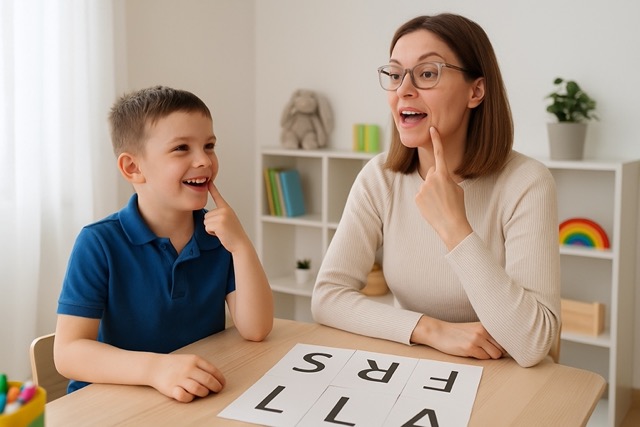
Young child practicing speech sounds with a speech therapist
Speech sound disorders affect a child’s ability to pronounce sounds clearly and be understood by others. These difficulties can impact confidence, learning, and social interaction—especially when they persist beyond typical developmental milestones.
This guide explains what speech sound disorders are, how they differ from language disorders, common types seen in children, and when speech therapy may be helpful. You’ll also find links to detailed condition-specific pages for deeper reading.
Quick Navigation
What Are Speech Sound Disorders?
Speech sound disorders are difficulties with producing speech sounds accurately and clearly. A child may know what they want to say but struggle to say it in a way others can understand.
Children with speech sound disorders may have difficulty:
- Pronouncing individual sounds correctly
- Combining sounds into words
- Speaking clearly enough to be understood
- Developing confidence when communicating
Research consistently shows that early intervention—especially before age 5—leads to better long-term outcomes.
Types of Speech Sound Disorders in Children
Speech sound disorders include several distinct conditions. Each affects speech in a different way and may require a specific therapeutic approach.
Articulation Disorders
Articulation disorders involve difficulty physically producing specific speech sounds.
Common signs include:
- Sound substitutions (saying “wabbit” for “rabbit”)
- Sound omissions (“ca” for “cat”)
- Distorted sounds (such as a lisp)
👉 Learn more about Articulation Disorders
Childhood Apraxia of Speech (CAS)
Childhood apraxia of speech is a motor speech disorder that affects how the brain plans and coordinates speech movements.
Children with CAS may:
- Produce inconsistent speech errors
- Struggle with longer or more complex words
- Have difficulty imitating speech sounds
👉 Learn more about Childhood Apraxia of Speech
Dysarthria in Children
Dysarthria is caused by weakness or poor control of the muscles used for speech.
Speech may sound:
- Slurred or slow
- Too quiet or unusually loud
- Nasal or breathy
👉 Learn more about Dysarthria in Children
Lisps
Lisps are a type of articulation disorder that affects sounds such as /s/ and /z/.
Common types include:
- Interdental (tongue between the teeth)
- Lateral (airflow escapes from the sides of the mouth)
Signs a Child May Have a Speech Sound Disorder
Some speech errors are part of normal development. Others may indicate a need for evaluation.
Age-Based Guidelines
- Age 3: Speech is about 75% understandable
- Age 4: Speech is about 90% understandable
- Age 5: Most speech sounds are produced clearly
Red Flags
- Frequent frustration when speaking
- Limited variety of speech sounds
- Speech that is difficult for unfamiliar listeners to understand
- Family history of speech or language disorders
- Feeding or swallowing difficulties
How Speech Therapy Helps Children with Speech Sound Disorders
Speech therapy for children focuses on improving clarity, consistency, and confidence in communication. Therapy plans are individualized based on a child’s age, diagnosis, and communication needs.
Evidence-based approaches may include:
- Articulation-based therapy
- Phonological approaches
- Motor-based therapy techniques
- Structured home practice with caregiver support
Parent Involvement and Home Support
Parents play a critical role in successful speech therapy outcomes. Simple daily activities can reinforce progress and support skill development.
Support may include:
- Practicing target sounds during play
- Creating a positive, pressure-free speaking environment
- Encouraging communication rather than perfection
Next Steps: Getting Started
If you’re concerned about your child’s speech clarity or sound development, a licensed speech-language pathologist can help.
The process often includes:
- A comprehensive speech evaluation
- Clear diagnosis and explanation
- An individualized therapy plan
- Ongoing progress monitoring
Early support helps children build strong communication skills and confidence that lasts.