
18 Month Old Not Talking: When to Worry and What to Do
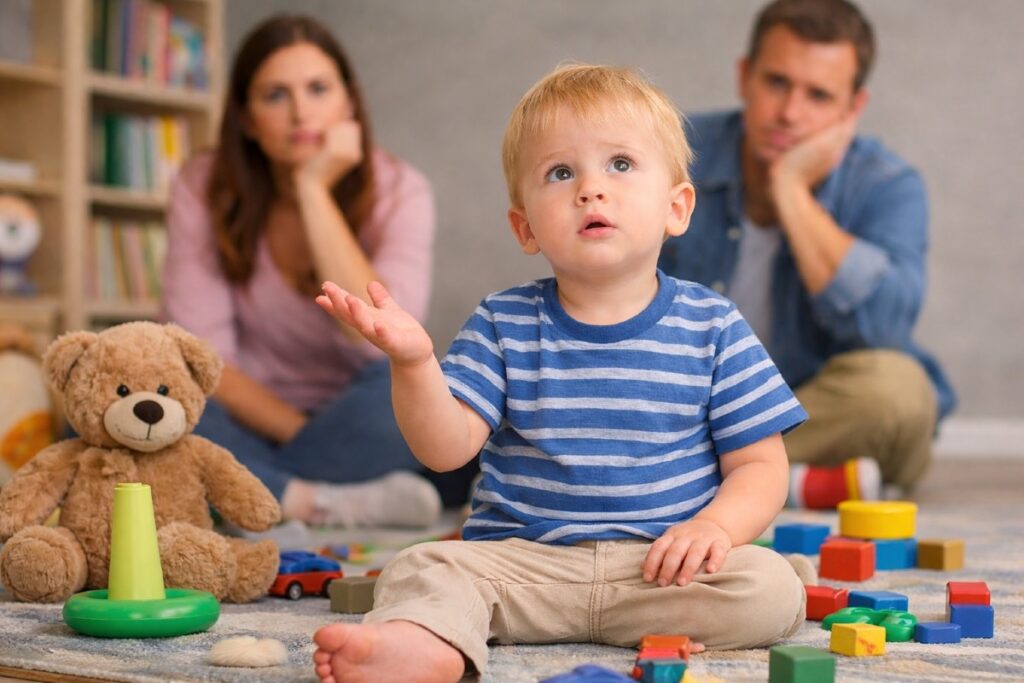
Few moments worry parents more than wondering whether their child is developing normally. One question I hear often, both as a speech-language pathologist and as a father of three, is this:
“My 18 month old isn’t talking yet. Should I be worried?”
It’s a reasonable concern. Around this age, many toddlers begin using words more consistently. Some point and chatter with excitement. Others seem quieter and rely more on gestures or sounds.
During my years working in early intervention, I’ve seen how wide the range of normal development can be. Some toddlers say many words early. Others take a little longer to find their voice. The key is not simply counting words. What matters more is whether communication is beginning to grow.
Let’s look at what speech development usually looks like around 18 months and how parents can tell when it may be time to ask for guidance.
Table of Contents
Is It Normal for an 18 Month Old Not to Talk?
Yes, it can be normal for some toddlers to say very little at 18 months. Children develop language at different speeds, just as they learn to walk or climb at different times.
However, most toddlers at this age are beginning to use at least a few meaningful words. They may say things like “mama,” “dada,” “ball,” or “bye-bye.” Even if the pronunciation isn’t perfect, the word should be used consistently and with meaning.
In addition to words, many 18-month-olds communicate through:
- pointing to objects
- shaking their head for “no”
- waving or clapping
- imitating sounds
- responding when their name is called
Communication includes much more than speech alone. Gestures, facial expressions, and understanding language are important building blocks.
If you want a broader overview of early development, you can review typical speech and language milestones by ageto see how communication skills gradually grow during the toddler years.
Parents who want a broader picture of early development can review typical speech and language milestones by age to see how communication skills usually grow during the toddler years.
What Words Should an 18 Month Old Be Saying?
There is no exact number that every toddler must reach, but most children around 18 months will say several wordsand try to imitate new ones.
Typical communication skills at this age may include:
- saying several recognizable words
- attempting to imitate new words
- pointing to pictures in books
- following simple directions
- showing interest in communicating wants and needs
Some toddlers say only a handful of words at this stage, while others say many more. The important thing is that communication is moving forward, even if slowly.
When speech remains very limited, parents may begin wondering whether a delay is developing.
Signs of Speech Delay at 18 Months
Every child develops differently, but there are signs that suggest speech development may need closer attention.
Parents may want to seek guidance if their toddler:
- says no clear words by 18 months
- rarely attempts to imitate sounds
- does not point to show interest
- seems frustrated when trying to communicate
- does not respond consistently to simple directions
- shows little interest in interacting with others
When I worked with families in early intervention, many parents told me they sensed something was not quite right before anyone else noticed. That instinct is often valuable.
If these concerns sound familiar, you may also want to read more about speech delay at 18 months and how speech-language professionals evaluate early communication.
Understanding More Than Talking
One of the most confusing parts of early language development is that toddlers often understand far more than they can say.
A child may follow directions, point to favorite toys, and respond to questions, yet say very few words. This difference between understanding language and speaking it is sometimes called an expressive language delay.
In my clinical experience, many children with strong understanding eventually develop speech with the right support. However, when expressive language remains limited, it may signal a developmental language delay that deserves evaluation.
If your child is approaching age two and still not speaking much, you may also want to read my 2 year old isn’t talking but understands for the next stage of guidance.
Why Some Toddlers Talk Later
Parents often ask why one child talks early while another takes longer. There is rarely a single explanation.
Several factors can influence speech development:
Late talker pattern
Some toddlers develop speech later but eventually catch up.
Hearing difficulties
Even mild hearing issues can affect how children learn speech sounds.
Developmental language delay
Some children need extra support building vocabulary and combining words.
Family history
Speech delays sometimes run in families.
Limited opportunities for interaction
Busy schedules, excessive screen time, or fewer face-to-face conversations may reduce opportunities to practice language.
Occasionally speech delay appears alongside broader developmental differences, but speech delay alone does not necessarily mean a serious disorder.
What Parents Can Do at Home
Parents play the most powerful role in helping toddlers learn to communicate.
Some of the most effective strategies are simple:
Talk during everyday routines
Describe what you are doing while dressing, cooking, or playing.
Follow your child’s lead
Talk about whatever your toddler is interested in at that moment.
Expand simple words
If your child says “ball,” you might respond with “big ball.”
Read picture books daily
Books introduce new words in a natural way.
Pause and give time to respond
Children often need a moment to attempt a sound or word.
These strategies encourage communication without putting pressure on the child.
When to Seek Help
If your toddler is 18 months old and not using words, it may be wise to ask for professional guidance.
An evaluation can help answer important questions:
- Is speech development within the expected range?
- Are there early signs of a delay?
- What strategies can support communication growth?
Children under age three may qualify for early intervention speech therapy, a public program designed to help toddlers with developmental delays.
Early evaluation does not automatically mean therapy will be needed. In many cases, parents simply receive reassurance and helpful strategies.
What Speech Therapy Looks Like for Toddlers
Speech therapy for young children is very different from what many parents imagine.
Sessions are usually play-based and interactive. A speech-language pathologist observes how the child communicates during play and helps parents learn ways to encourage language during daily routines.
Strategies may include:
- modeling simple words
- encouraging imitation
- building vocabulary through play
- supporting early two-word combinations
Parents are actively involved because the real progress happens during everyday interaction at home.
If you want a broader picture of this process, you can learn more about speech therapy for toddlers (0–3): signs, help & what to expect.
When to Contact a Speech Therapist
If your concerns continue or speech does not begin to develop, speaking with a professional can provide clarity.
A speech-language pathologist can evaluate communication skills and help determine whether extra support would benefit your child.
If you would like professional guidance, you can find a speech therapist near you who specializes in early childhood communication.
Signs Your Toddler Is Making Progress
Even small changes can signal positive growth.
Encouraging signs include:
- attempting to imitate sounds
- pointing more frequently
- responding to simple directions
- increased interest in books and conversation
- new words appearing gradually
Progress often begins with small steps before vocabulary expands more quickly.
Frequently Asked Questions
Is it normal for an 18 month old not to talk?
Some toddlers say only a few words at this age. However, most show signs of communication development such as gestures, imitation, and understanding language.
How many words should an 18 month old say?
Many toddlers say several words by 18 months, though the exact number varies widely.
Should parents wait until age two before seeking help?
Not necessarily. If speech is very limited or parents are concerned, seeking guidance earlier can provide reassurance and helpful strategies.
Final Thoughts
In my years working with young children and families, I’ve learned that parents often recognize communication concerns early. That awareness is valuable.
Some toddlers simply take longer to talk. Others benefit from early support that helps language grow during an important stage of development.
If your 18 month old is not talking yet, the most helpful approach is to stay observant, keep communication playful and frequent, and seek guidance if progress seems slow.
Early attention to speech development can open the door to stronger communication, confidence, and connection as your child grows.